Effective grade
Reconcile representative material against the resource model and quantify the effects of selectivity and material handling.

Thor Project · Bulk Sample Program
A planned 10,000-tonne program designed to convert geological understanding into mining, metallurgical and engineering data for future economic studies.
The program is intended to generate decision-grade inputs; it is not a production decision or a guarantee of future economic results.
01 · Program purpose
Thor is a complex polymetallic system. The bulk sample is designed to test how representative material behaves at a larger scale—how it breaks, upgrades, separates and converts into marketable concentrate streams.
Reconcile representative material against the resource model and quantify the effects of selectivity and material handling.
Generate larger-scale physical and mechanical inputs for crushing, handling, water management and facility design.
Produce representative concentrate for quality, payable-metal and potential penalty-element evaluation.
Replace selected assumptions with measured program data before advancing to more capital-intensive studies.
02 · Engineering & flowsheet
Novus Engineering and Gekko Systems developed the pre-concentration concept around a compact, staged circuit. Each stage is intended to produce measurable operating and metallurgical inputs.
True Fissure and Broadview material prepared for the program.
Controlled size reduction creates consistent feed for separation.
A Gekko inline pressure jig separates higher-density mineralized material.
Mass reduction is measured before concentrate is moved off site.
Locked-cycle work evaluates lead, zinc, silver and gold recovery pathways.
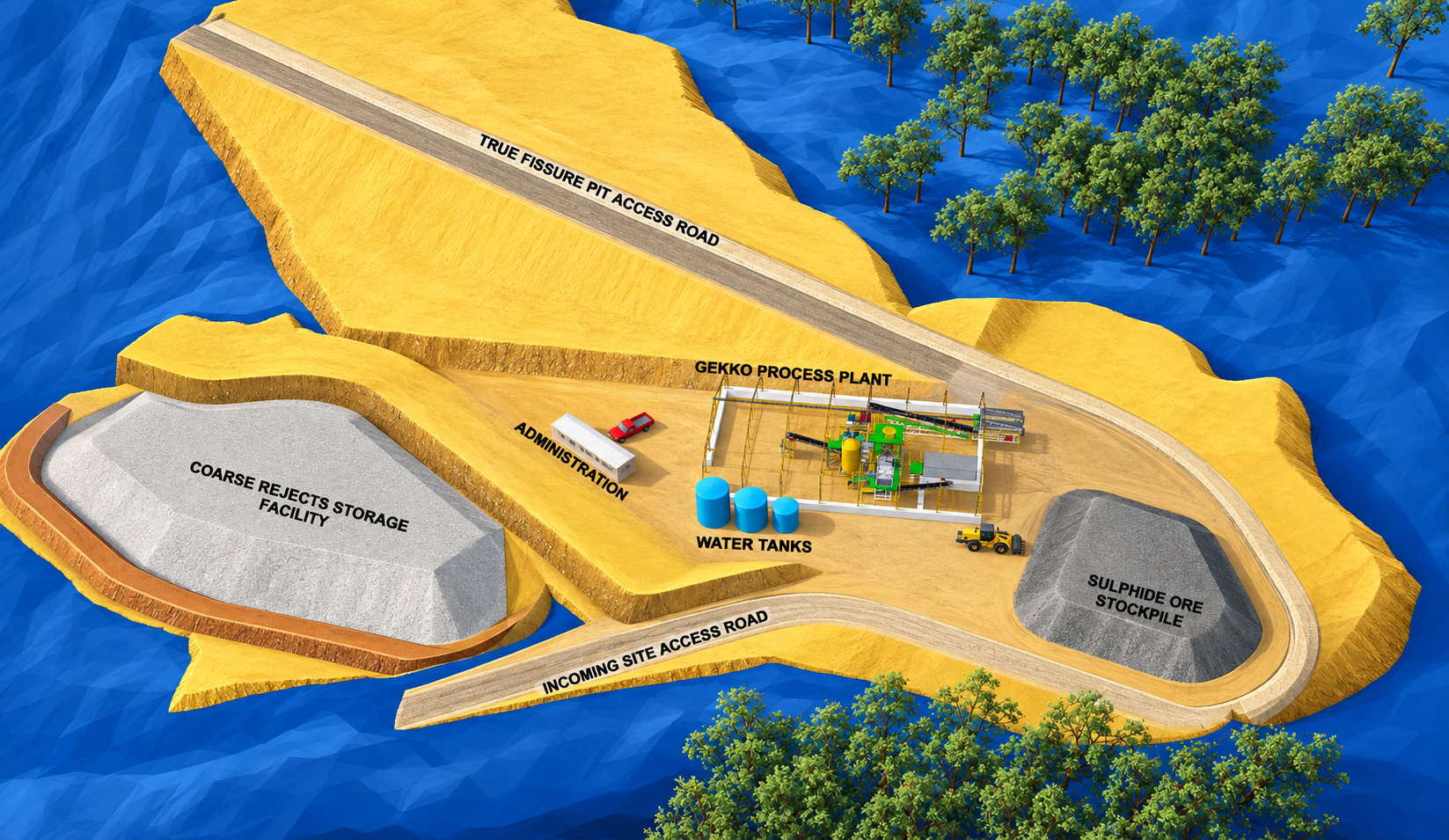
Compact site architecture
The engineering concept co-locates the process plant, stockpile, water storage, administration and coarse-rejects storage around existing access. The image is conceptual and remains subject to detailed engineering and approvals.
Engineering reference: Thor Pre-Concentration Report (PDF).
03 · Metallurgical goals
The values below are program targets or reported test-work indications supplied in the project brief. They are not forecasts of commercial production performance.
Targets and test-work indications require confirmation through the bulk sample and subsequent technical studies.
Determine where gold reports through the circuit and evaluate appropriate recovery options, including cyanide-related test work where applicable.
Evaluate repeatable concentrate performance, circulating loads and the separation of lead- and zinc-bearing products.
Track antimony, indium, cadmium and gallium to understand recovery pathways, payability and potential penalties.
04 · Geotechnical & ESG
The program is more than a metallurgy exercise. Site investigation, water management, coarse-rejects storage and engagement all shape whether the concept can advance responsibly.
Company materials describe 12 auger holes, two core holes and bedrock mapping at the True Fissure facilities area.
The CRSF concept integrates containment, runoff collection and water-treatment interfaces into the site plan.
Planned work includes water-balance refinement and terrain-stability evaluation, subject to program scheduling and approvals.
Company materials state that site-investigation information has been shared with the Ktunaxa Nation as part of the project’s engagement process.
05 · Regulatory clarity
On January 25, 2024, Taranis reported that the CRA Appeals Division reversed an earlier position and accepted certain 2017–2018 Thor bulk-sample permitting expenditures as Canadian Exploration Expenses.
Program register
| Category | Current program detail | Context |
|---|---|---|
| Scale & permit | Up to 10,000 tonnes · EMLI MX-5-602 | Permit details are company-reported and should be checked against the current instrument. |
| Validity | Company-reported through August 31, 2028 | Reported two-year extension; confirm before publication. |
| Material | True Fissure and Broadview | Representative feed / stockpiled-material plan to be confirmed in final operating documents. |
| Process design | Novus Engineering + Gekko Systems | Concept specifications and pre-concentration flowsheet completed. |
| Site investigation | Knight Piésold | Company materials describe auger holes, core holes and bedrock mapping. |
| Tax treatment | CRA appeal reversal | Certain 2017–2018 permitting expenditures accepted as CEE. |
Publication check: confirm the permit number, expiry date, geotechnical counts and current material-feed plan against the latest filed or ministry-issued documents before launch.
The next engineering step
Explore the technical foundation behind the program, the targets beyond the resource and the engineering report that defines the pre-concentration concept.